
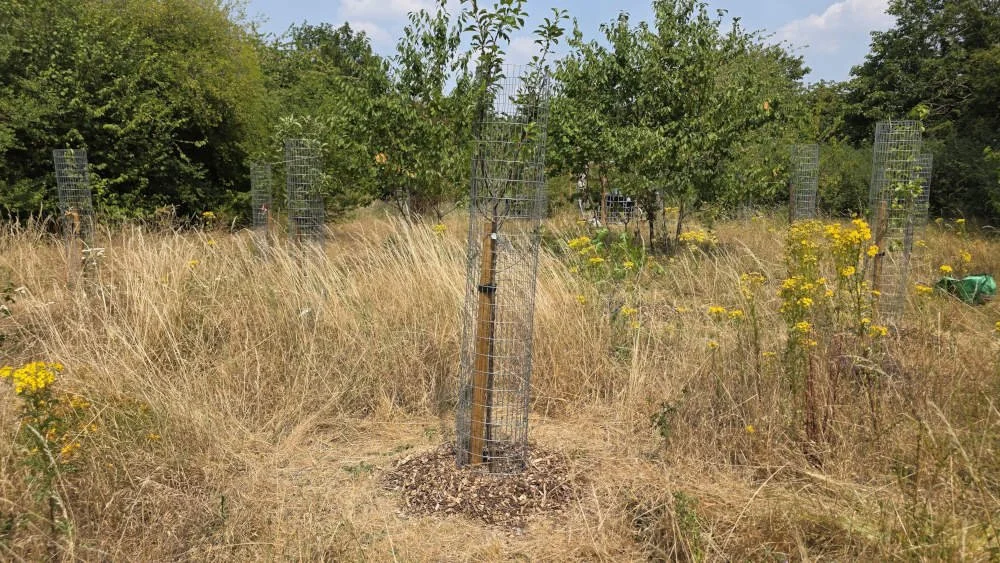
It's been a very dry July, and our Tree Stewards have been working hard to keep the Lords Mead community orchard's young trees happy and hydrated. This week a group of us met up to do the watering together, but once that was done and the sun went down, it was time to swap watering cans for bat detectors and head out on the hunt for some nocturnal visitors!
32 trees and a lot of water
We're in our first year of establishing the Lords Mead community orchard, and it's fair to say the weather has given our young trees a bit of a baptism of fire.
July has been exceptionally dry. According to the Environment Agency, the month has so far received just 7% of its long-term average rainfall across England, falling to just 1% across southern England.
For our newly planted orchard, that has made keeping 32 young trees healthy and watered quite a challenge. Our trees are only one or two years old and were planted earlier this year, so they haven't yet had the chance to develop a strong root system. During dry weather, each tree needs around 20 litres of water a week — rising to around 40 litres when temperatures climb above 30°C. With 32 trees in the orchard, that's a lot of water!
We've been working on rainwater harvesting systems for the site, but there's one small problem... We need some rain to fill them!
Thankfully, our brilliant team of volunteers — or Tree Stewards, as we've started calling them — have been busy ferrying watering cans and containers from the Lords Mead allotments. The allotment, along with Wiltshire Council, have very kindly allowed us to use their water supply while we wait for the skies to do their bit.
Hopefully, we'll get some proper rain soon. Our watering cans could really do with a rest!
From watering cans to bat detectors
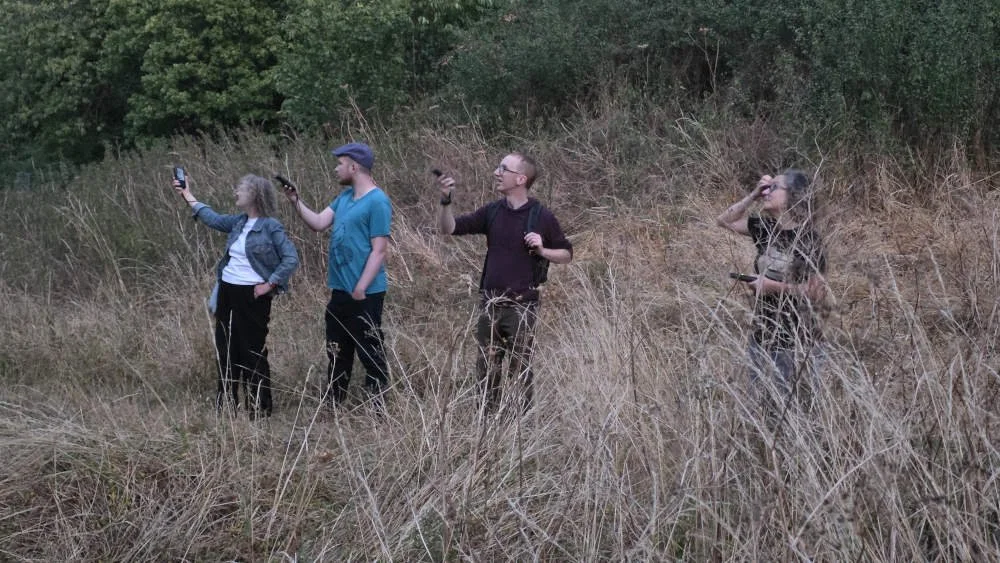
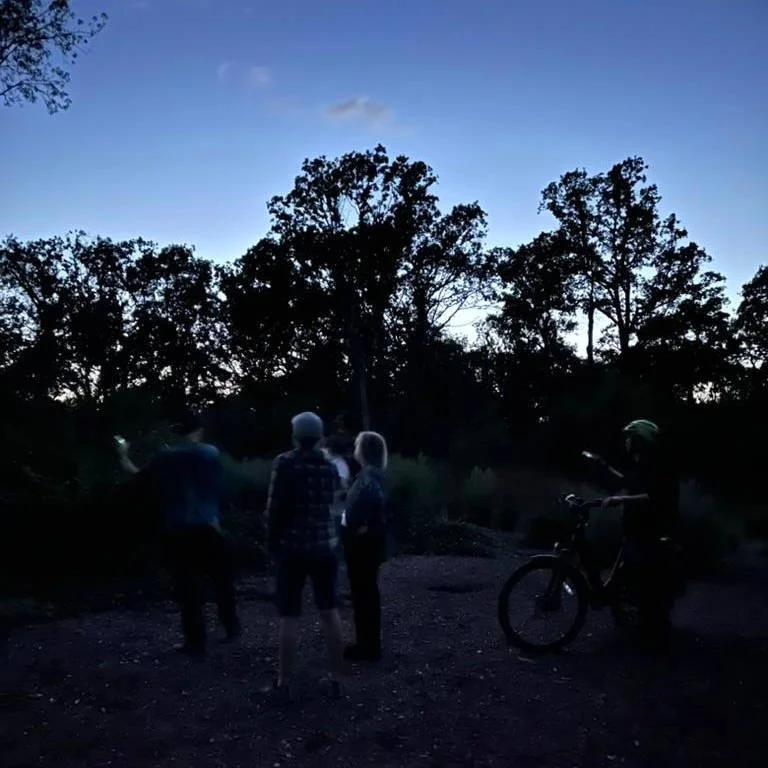
After finishing the watering, Ben decided the evening wasn't quite over yet. Out came our bat detectors, and we set off on an impromptu bat walk around the orchard.
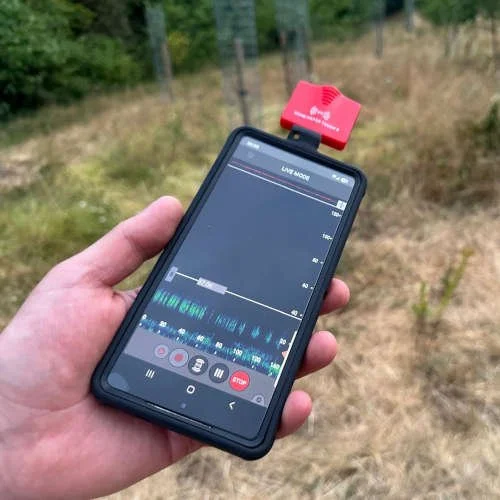
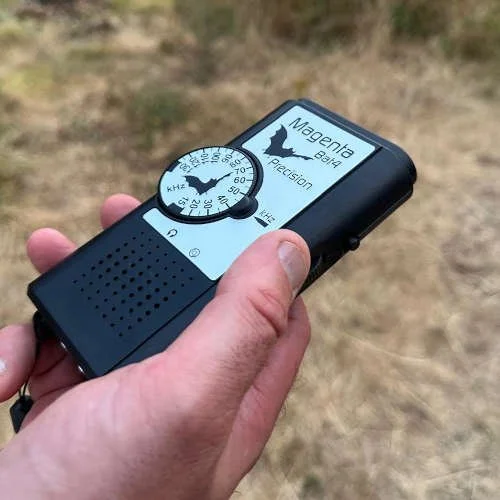
As part of our ongoing surveys of Lords Mead, we're trying to understand what wildlife is already using the site and what we can do to make it an even better home for nature. Over the past year, Ben has been running successful bat walks across Chippenham, sharing his knowledge and enthusiasm for these amazing little creatures. So this was a perfect opportunity to find out whether any bats were utalising the orchard.
As the sun disappeared, we got out the detectors and waited patiently for the birds to head off to bed and the bats to begin their night shift.
It didn't take long.
Click, click, click...
Our first visitor was a Common Pipistrelle, one of the UK's smallest and most widespread bats.
Although we detected a few bats flying over the orchard, there weren't as many hunting around the trees as we might have hoped. One possible explanation is the exceptionally dry weather. The small overflow stream that runs near the orchard has dried up, and the lack of water may also be affecting insect numbers — meaning there could simply be less food around for the bats.
So perhaps our bats were finding better hunting grounds elsewhere.
A surprising discovery
As we were already out with the detectors, we decided to head towards the nearby Vincents Wood to see what we could find. Even walking through the suburban streets on the way there, we found quite a few bats happily hunting around street lights and over people's gardens.
It was a great reminder that wildlife doesn't only depend on big parks, woods and nature reserves. Our own gardens matter too.
Ponds, flowers, trees and hedges can all provide valuable habitat and help support the insects that bats and other wildlife rely on. During a dry summer like this one, these pockets of nature can become particularly important.
At Vincents Wood, things got even more exciting. Alongside Pipistrelles, we detected two larger species: Noctule and Serotine bats.
Both are considerably larger than Pipistrelles, and detecting them was a real treat. Noctules are one of the UK's larger bats and often hunt high above the ground, while Serotines are also large bats associated with woodland edges, grassland and other open habitats. Serotines are classed as vulnerable and only found in southern half of the UK.
For a group that had started the evening carrying watering cans, ending it listening to the largest bat species in the UK hunting overhead was a pretty good result!
Building a better home for wildlife
While we're slightly disappointed that the orchard wasn't buzzing with bats, we're actually really pleased with what the evening told us. These surveys give us a baseline — a picture of the wildlife currently using the site. As the orchard grows, the trees mature and we introduce more plants and habitats, we can hopefully watch that picture change.
Perhaps, as we create more food, shelter, flowers and water around the orchard, we'll see more bats choosing to stick around for dinner.
For now, we'll keep watering the trees, planting for biodiversity and keeping an eye — and an ear — on what wildlife is visiting. And hopefully, we'll get some rain soon.
If you'd like to help us look after the orchard and become a Tree Steward, we'd love to hear from you.
And if you'd like to join Ben on one of his more structured bat walks, where you can learn more about these fascinating creatures and experience them for yourself, you can find out more about the next bat walk here.
It really is quite a thrill when the detector suddenly goes...
CLICK, CLICK, CLICK!